Free Chord Progression Chart
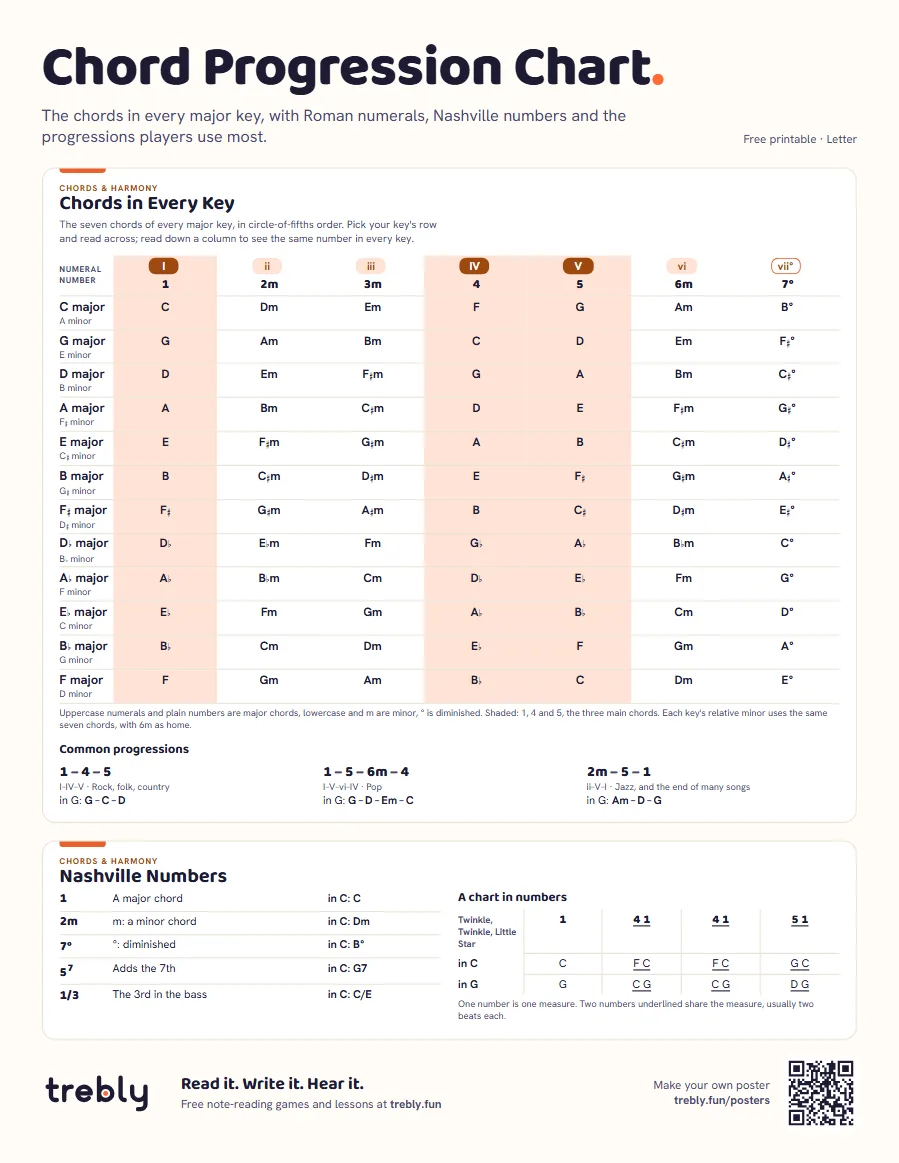
The seven chords of every major key on one page, in circle-of-fifths order, with Roman numerals and Nashville numbers on top and the progressions players use most. Free in eight sizes, in US or UK music terms.
Make it yours: see it in another style
Any US home printer (8.5 × 11 in). A binder, desk or music stand.
Download the PDFLetter, US · 53 KB
Customize this posterChange the sections, style and colors, and add your own title, in the Music Theory Poster Maker. $9 PDF.
✓ Your PDF is downloading
Make this poster yours
- Your own title, like “Mrs. Green’s Music Room”
- Only the sections you teach, or add more
- A different style: Dark, Modern or Minimal
Customize this poster →$9 PDF · try it free first
On the Letter poster (2 sections)
- Chords in Every Key
- Nashville Numbers
Plus a practice tip in the space left over.
The bigger the poster, the more fits: A2 and larger have all 4 sections.
All sizes and files
| Size | Dimensions | Sections | US terms | UK terms |
|---|---|---|---|---|
| Letter | 216 × 279 mm · 8.5 × 11 in | 2 | PDF, 53 KB | PDF, 53 KB |
| A4 | 210 × 297 mm · 8.3 × 11.7 in | 2 | PDF, 54 KB | PDF, 54 KB |
| 11 × 17 in | 279 × 432 mm · 11 × 17 in | 3 | PDF, 64 KB | PDF, 64 KB |
| A3 | 297 × 420 mm · 11.7 × 16.5 in | 4 | PDF, 80 KB | PDF, 80 KB |
| A2 | 420 × 594 mm · 16.5 × 23.4 in | 4 | PDF, 81 KB | PDF, 81 KB |
| 18 × 24 in | 18 × 24 in · 457 × 610 mm | 4 | PDF, 83 KB | PDF, 83 KB |
| A1 | 594 × 841 mm · 23.4 × 33.1 in | 4 | PDF, 90 KB | PDF, 90 KB |
| 24 × 36 in | 24 × 36 in · 610 × 914 mm | 4 | PDF, 91 KB | PDF, 91 KB |
What’s on the chord progression chart
- Chords in every key: all 12 major keys, one row each, in circle-of-fifths order (C, G, D, A, E, B, F♯, D♭, A♭, E♭, B♭, F), with each key’s relative minor beside it.
- Roman numerals and Nashville numbers over every column: I ii iii IV V vi vii° and 1 2m 3m 4 5 6m 7°. Read down a column to see the same chord in every key.
- The three main chords shaded: 1, 4 and 5 (I, IV and V), the chords most songs lean on.
- Common progressions: 1–4–5, 1–5–6m–4 and 2m–5–1, each in numbers, numerals and chords.
- Nashville numbers explained: what 2m, 7°, 5⁷ and 1/3 mean, and a short number chart played in C and in G.
- Roman numerals and what each chord does (11 × 17 in and larger), and more progressions with the 12-bar blues (A3 and larger).
Every chord is worked out from the key’s scale and checked, one letter per scale step, so F♯ major has E♯°, not F°.
How to use it
- Find your key’s row and read across. Those seven chords sound right together in that key.
- Transpose a song: find its chords in one row, then read the same columns in another row. 1–4–5 in G (G, C, D) becomes D, G, A in D.
- Play a progression in any key: pick a progression from the bottom, then take its numbers from your key’s row.
- Switch to the relative minor: a song in E minor uses the same seven chords as G major, with 6m (Em) as home.
Learn it step by step
The poster is a reminder; these free lessons and guides teach each part, with notes you can play and hear.
- Chords in Every Key
- Chords in a Key · The Nashville Number System · Lesson 32: Chords in a Key
- Nashville Numbers
- The Nashville Number System · Chords in a Key
- Common Progressions
- Lesson 32: Chords in a Key · Chords in a Key
- Roman Numerals
- Lesson 32: Chords in a Key · Chords in a Key
Questions
Is it really free? Yes. Download it, print as many copies as you like, and share the link. No email or account.
What’s the difference between Roman numerals and Nashville numbers? They name the same chords. Roman numerals show minor chords in lowercase (ii, vi); Nashville numbers use plain digits with an m (2m, 6m). The Nashville number system guide explains how a number chart works.
Why only major keys? Each minor key shares its chords with its relative major, shown beside every row: A minor uses the chords of C major, starting from 6m. For the minor keys in their own rows, with the harmonic minor’s V chord and minor progressions, print the free minor key chord chart.
Which size should I print? Letter or A4 has the full table, the progressions and Nashville numbers. 11 × 17 in adds Roman numerals, and A3 and larger add more progressions and the 12-bar blues.