Free Minor Key Chord Chart
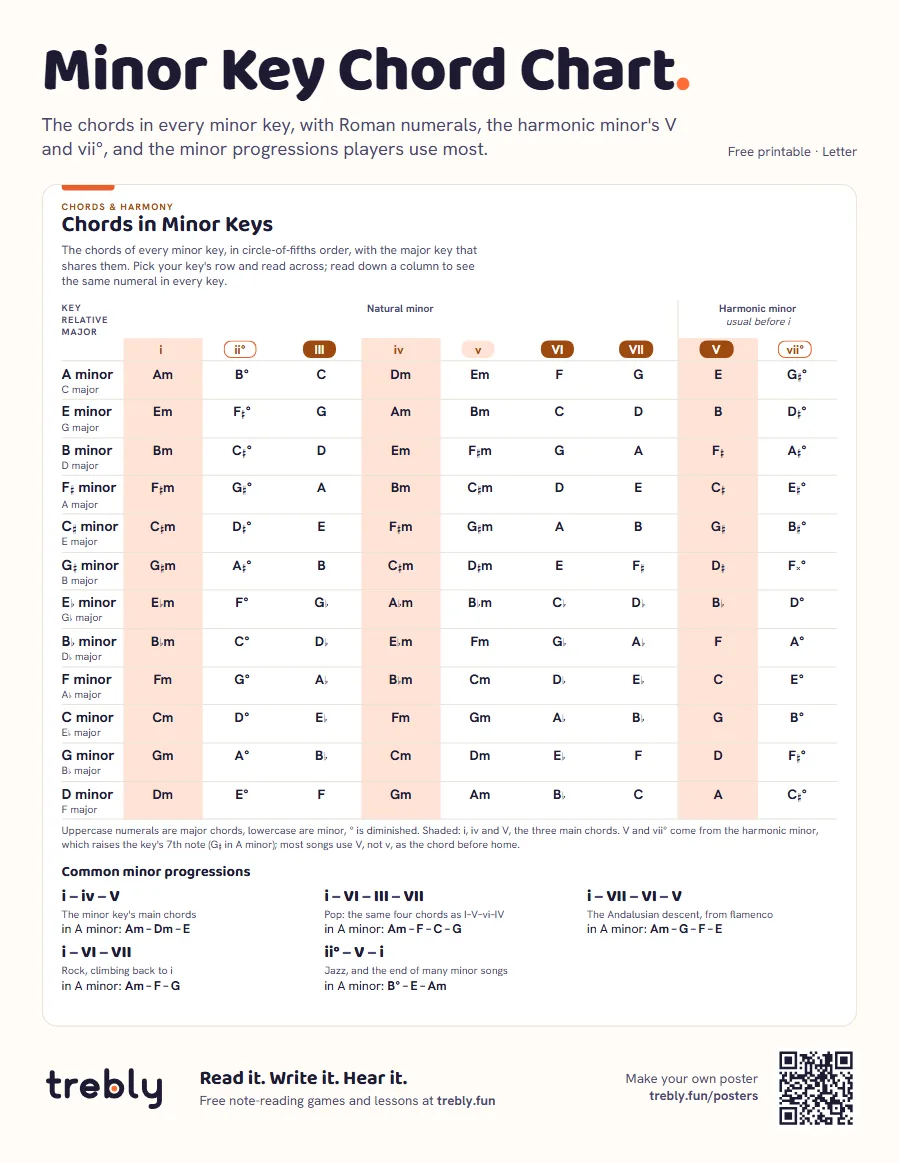
This minor key chord chart has the chords of every minor key on one page, in circle-of-fifths order, each with its relative major, plus the harmonic minor's V and vii° and the minor progressions players use most. Free in eight sizes, in US or UK music terms.
Make it yours: see it in another style
Any US home printer (8.5 × 11 in). A binder, desk or music stand.
Download the PDFLetter, US · 52 KB
Customize this posterChange the sections, style and colors, and add your own title, in the Music Theory Poster Maker. $9 PDF.
✓ Your PDF is downloading
Make this poster yours
- Your own title, like “Mrs. Green’s Music Room”
- Only the sections you teach, or add more
- A different style: Dark, Modern or Minimal
Customize this poster →$9 PDF · try it free first
On the Letter poster (1 sections)
- Chords in Minor Keys
Plus a practice tip in the space left over.
The bigger the poster, the more fits: A2 and larger have all 5 sections.
All sizes and files
| Size | Dimensions | Sections | US terms | UK terms |
|---|---|---|---|---|
| Letter | 216 × 279 mm · 8.5 × 11 in | 1 | PDF, 52 KB | PDF, 52 KB |
| A4 | 210 × 297 mm · 8.3 × 11.7 in | 1 | PDF, 53 KB | PDF, 53 KB |
| 11 × 17 in | 279 × 432 mm · 11 × 17 in | 4 | PDF, 81 KB | PDF, 80 KB |
| A3 | 297 × 420 mm · 11.7 × 16.5 in | 4 | PDF, 81 KB | PDF, 81 KB |
| A2 | 420 × 594 mm · 16.5 × 23.4 in | 5 | PDF, 95 KB | PDF, 95 KB |
| 18 × 24 in | 18 × 24 in · 457 × 610 mm | 5 | PDF, 96 KB | PDF, 96 KB |
| A1 | 594 × 841 mm · 23.4 × 33.1 in | 5 | PDF, 97 KB | PDF, 97 KB |
| 24 × 36 in | 24 × 36 in · 610 × 914 mm | 5 | PDF, 97 KB | PDF, 97 KB |
What’s on the minor key chord chart
- Chords in every minor key: all 12 minor keys, one row each, in circle-of-fifths order (A, E, B, F♯, C♯, G♯, E♭, B♭, F, C, G, D minor), with each key’s relative major beside it.
- Roman numerals over every column: i ii° III iv v VI VII from the natural minor. Read down a column to see the same chord in every key.
- The harmonic minor’s V and vii° in two extra columns: the chords most minor songs use before going home (E and G♯° in A minor).
- The three main chords shaded: i, iv and V.
- Common minor progressions: i–iv–V, i–VI–III–VII, i–VII–VI–V (the Andalusian descent), i–VI–VII and ii°–V–i, each written out in A minor.
- Why minor keys use a major V, Nashville numbers in minor keys and the minor 12-bar blues (11 × 17 in and larger), and cadences (A2 and larger).
Every chord is worked out from the key’s scale and checked, one letter per scale step, so G♯ minor’s vii° is F𝄪° (F double sharp), not G°.
How to use it
- Find your key’s row and read across. Those chords sound right together in that minor key.
- Use V, not v, before home. In A minor, E major pulls back to Am far more strongly than Em does. That’s why the chart gives both.
- Transpose a song: find its chords in one row, then read the same columns in another row. i–iv–V in A minor (Am, Dm, E) becomes Em, Am, B in E minor.
- Borrow from the relative major: a song in A minor uses the same chords as C major. The chord progression chart has every major key in the same layout.
Learn it step by step
The poster is a reminder; these free lessons and guides teach each part, with notes you can play and hear.
- Chords in Minor Keys
- Chords in a Key · Relative Minor and Major Keys · Lesson 32: Chords in a Key
- Why Minor Keys Use a Major V
- Chords in a Key · Lesson 33: The Minor Scale
- Nashville Numbers in Minor Keys
- The Nashville Number System
- Minor 12-Bar Blues
- Chords in a Key
- Cadences
- Chords in a Key
Questions
Is it really free? Yes. Download it, print as many copies as you like, and share the link. No email or account.
Why does a minor key have a major V chord? In the natural minor, the 7th note is a whole step below home, so the chord on 5 is minor. Raising that note a half step (G to G♯ in A minor) gives the harmonic minor, and the chord on 5 becomes major. Its raised note leads straight up to home, so V–i sounds finished. Our guide to chords in a key explains the minor-key chords in more detail.
Why is E♭ minor shown and not D♯ minor? They sound the same. E♭ minor (six flats) is the more common spelling; D♯ minor uses six sharps and the same chords spelled with sharps.
How do Nashville numbers work in minor keys? Players number them two ways: from the minor home (Am is 1m, so E is 5) or from the relative major (Am is 6m, so E is 3). The 11 × 17 in and larger sizes show A minor’s chords both ways. Agree with your band which you use; the Nashville number system guide has more.
What is a relative major? The major key with the same key signature and the same natural-minor chords: its home note is three half steps above the minor’s. The relative minor guide lists every pair.
Which size should I print? Letter or A4 has the full table and the progressions: enough for a music stand. 11 × 17 in and larger add why minor keys use a major V, Nashville numbers and the minor 12-bar blues.
Can I make my own version? Yes. In the Music Theory Poster Maker you can put your name or your studio’s on it, choose the sections (the major keys too) and pick a style. Personalized posters are $9 as a PDF.