Free Rhythm and Note Reading Poster
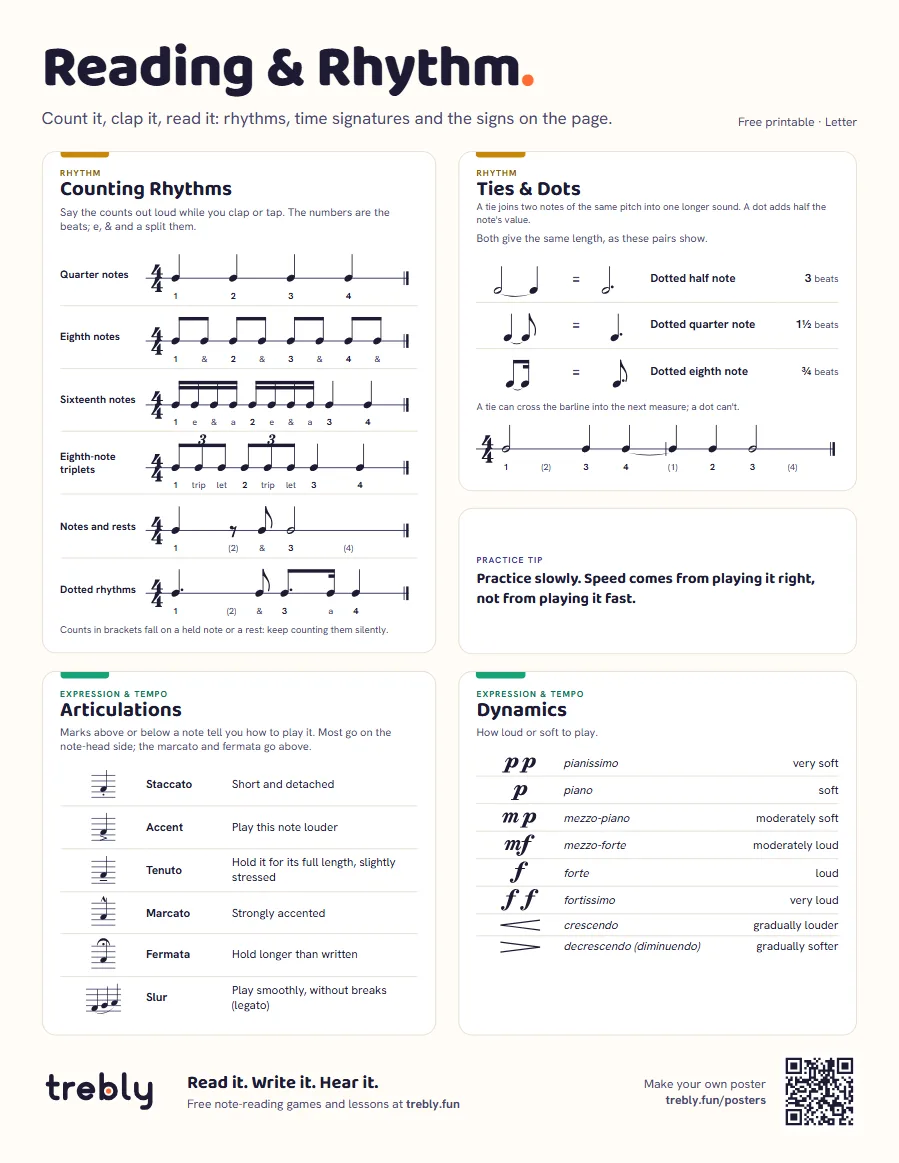
Count it, clap it, read it: how to count rhythms, what ties and dots do, simple and compound time, and the signs you meet on the page. Our Reading & Rhythm poster, free in eight sizes, in US or UK music terms.
Make it yours: see it in another style
Any US home printer (8.5 × 11 in). A binder, desk or music stand.
Download the PDFLetter, US · 50 KB
Customize this posterChange the sections, style and colors, and add your own title, in the Music Theory Poster Maker. $9 PDF.
✓ Your PDF is downloading
Make this poster yours
- Your own title, like “Mrs. Green’s Music Room”
- Only the sections you teach, or add more
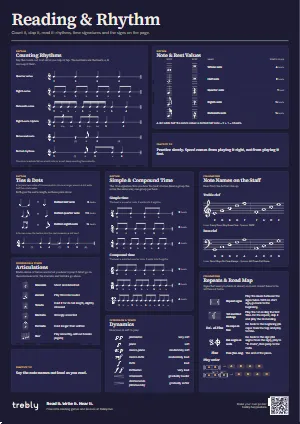
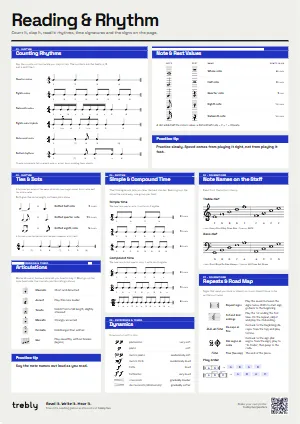
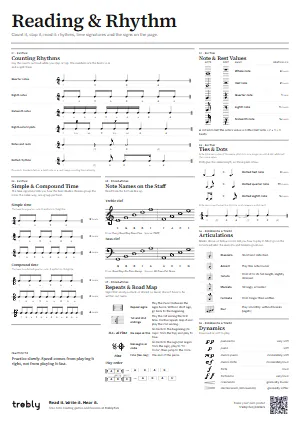
- A different style: Dark, Modern or Minimal
Customize this poster →$9 PDF · try it free first
On the Letter poster (4 sections)
- Counting Rhythms
- Ties & Dots
- Articulations
- Dynamics
Plus a practice tip in the space left over.
The bigger the poster, the more fits: A2 and larger have all 8 sections.
All sizes and files
| Size | Dimensions | Sections | US terms | UK terms |
|---|---|---|---|---|
| Letter | 216 × 279 mm · 8.5 × 11 in | 4 | PDF, 50 KB | PDF, 50 KB |
| A4 | 210 × 297 mm · 8.3 × 11.7 in | 4 | PDF, 50 KB | PDF, 50 KB |
| 11 × 17 in | 279 × 432 mm · 11 × 17 in | 4 | PDF, 51 KB | PDF, 50 KB |
| A3 | 297 × 420 mm · 11.7 × 16.5 in | 7 | PDF, 67 KB | PDF, 67 KB |
| A2 | 420 × 594 mm · 16.5 × 23.4 in | 8 | PDF, 88 KB | PDF, 88 KB |
| 18 × 24 in | 18 × 24 in · 457 × 610 mm | 8 | PDF, 88 KB | PDF, 88 KB |
| A1 | 594 × 841 mm · 23.4 × 33.1 in | 8 | PDF, 99 KB | PDF, 99 KB |
| 24 × 36 in | 24 × 36 in · 610 × 914 mm | 8 | PDF, 99 KB | PDF, 99 KB |
What’s on the rhythm poster
- Counting Rhythms: short rhythms with the counts written under them, from quarter notes to “1 e & a” sixteenths and triplets.
- Note & Rest Values: every note and rest with its beats, and the common time signatures.
- Ties & Dots: the same lengths written both ways, and why a tie can cross a bar line when a dot can’t.
- Simple & Compound Time: why 6/8 feels like two beats, counted “1 & a 2 & a”.
- Note Names on the Staff: the treble and bass clef lines and spaces.
- Articulations: staccato, accent, tenuto, marcato, fermata and slur, with what each asks you to do.
- Repeats & Road Map: repeat signs, first and second endings, D.C. al Fine and D.S. al Coda, in the order you play them.
- Dynamics: from pianissimo to fortissimo, crescendo and diminuendo.
A4 holds the four sections you’ll check most while playing; A3 has seven, and A2 and larger have all eight.
How to use it
- Count out loud: point to a rhythm on the poster, say the counts, then clap it. The counts are printed under every note.
- Before you play a new piece: find its time signature, any repeat signs and the dynamics on the poster first, so the page holds no surprises.
- In band or choir: at A2 or 24 × 36 in the symbols read from the back row, which settles “which way does D.S. al Coda go?” quickly.
Learn it step by step
The poster is a reminder; these free lessons and guides teach each part, with notes you can play and hear.
- Counting Rhythms
- Lesson 12: The Beat · Lesson 17: Measures, Rests and Counting · Lesson 19: Reading a Rhythm · How to Read Rhythm · Read Music in Time
- Note & Rest Values
- Lesson 15: How Long Is a Note? · Music Note Values · Note Value Chart · Time Signatures
- Ties & Dots
- Music Note Values · How to Read Rhythm
- Simple & Compound Time
- How to Count Time Signatures · Time Signatures
- Note Names on the Staff
- Lesson 4: The Spaces Spell FACE · Lesson 5: Every Good Boy Does Fine · Lesson 23: Good Boys Do Fine Always · Lesson 24: All Cows Eat Grass · Treble Clef Notes · Bass Clef Notes
- Articulations
- Music Notation Symbols
- Repeats & Road Map
- Music Notation Symbols
- Dynamics
- Music Notation Symbols
Questions
Is it really free? Yes. Download it, print as many copies as you like, and share the link. No email or account.
Which size should I print? A4 for a binder or music stand; A2 or larger for a classroom wall with all eight sections.
US or UK terms? The US version says measure and quarter note; the UK version bar and crotchet. The rhythms are the same.