Free CAGED System Chart
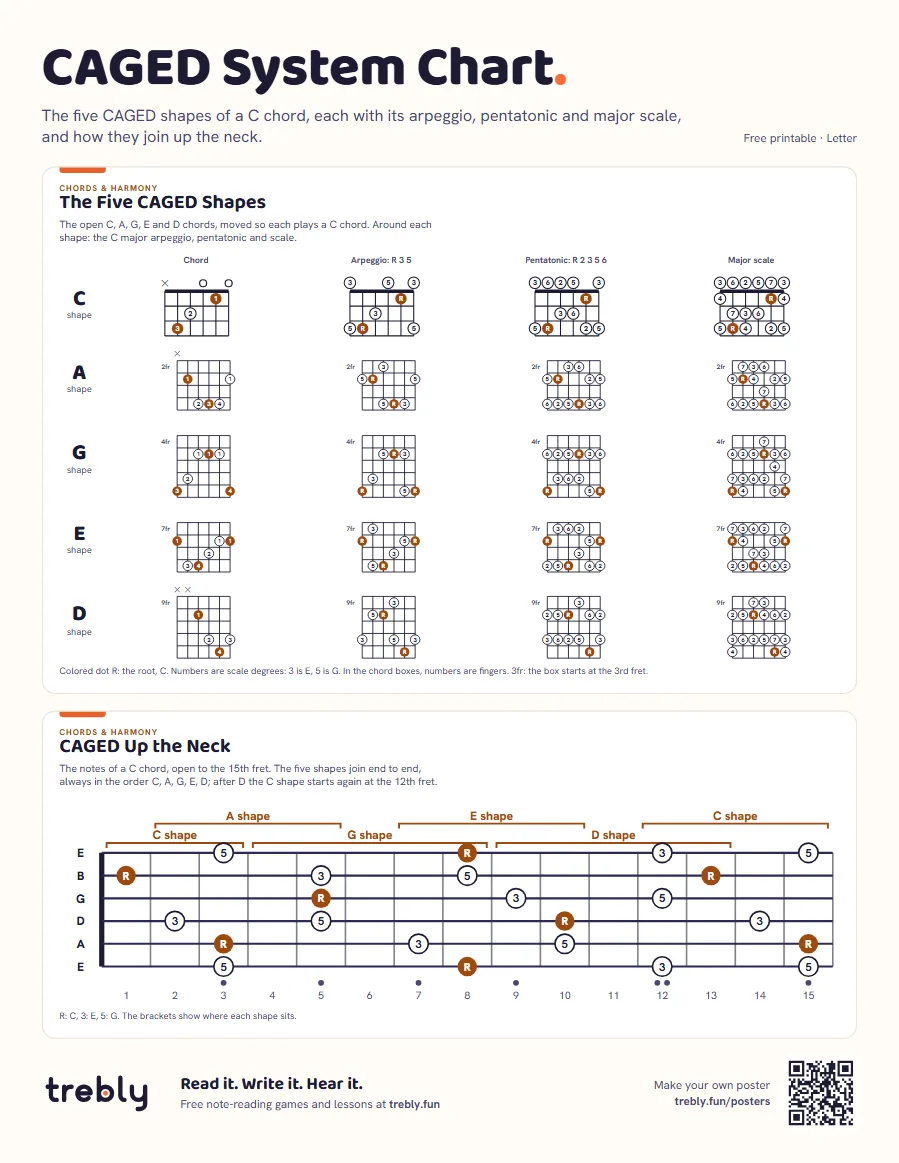
A CAGED chord chart with the five shapes of a C chord, each with its arpeggio, major pentatonic and major scale, and one long neck showing how the shapes join end to end. Free in eight sizes, in US or UK music terms.
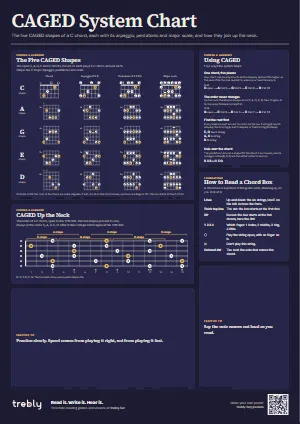
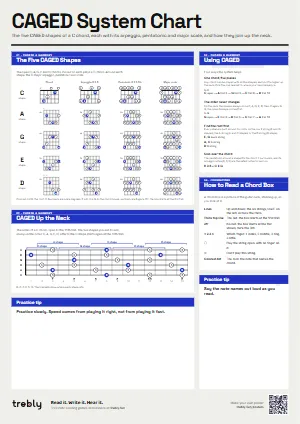
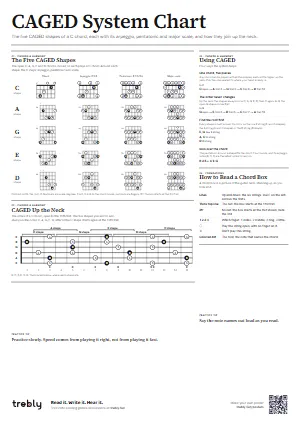
Make it yours: see it in another style
Any US home printer (8.5 × 11 in). A binder, desk or music stand.
Download the PDFLetter, US · 82 KB
Customize this posterChange the sections, style and colors, and add your own title, in the Music Theory Poster Maker. $9 PDF.
✓ Your PDF is downloading
Make this poster yours
- Your own title, like “Mrs. Green’s Music Room”
- Only the sections you teach, or add more
- A different style: Dark, Modern or Minimal
Customize this poster →$9 PDF · try it free first
On the Letter poster (2 sections)
- The Five CAGED Shapes
- CAGED Up the Neck
Plus a practice tip in the space left over.
The bigger the poster, the more fits: A2 and larger have all 4 sections.
All sizes and files
| Size | Dimensions | Sections | US terms | UK terms |
|---|---|---|---|---|
| Letter | 216 × 279 mm · 8.5 × 11 in | 2 | PDF, 82 KB | PDF, 83 KB |
| A4 | 210 × 297 mm · 8.3 × 11.7 in | 2 | PDF, 94 KB | PDF, 94 KB |
| 11 × 17 in | 279 × 432 mm · 11 × 17 in | 3 | PDF, 106 KB | PDF, 106 KB |
| A3 | 297 × 420 mm · 11.7 × 16.5 in | 3 | PDF, 106 KB | PDF, 106 KB |
| A2 | 420 × 594 mm · 16.5 × 23.4 in | 4 | PDF, 154 KB | PDF, 154 KB |
| 18 × 24 in | 18 × 24 in · 457 × 610 mm | 4 | PDF, 160 KB | PDF, 160 KB |
| A1 | 594 × 841 mm · 23.4 × 33.1 in | 4 | PDF, 162 KB | PDF, 162 KB |
| 24 × 36 in | 24 × 36 in · 610 × 914 mm | 4 | PDF, 162 KB | PDF, 162 KB |
What’s on the CAGED system chart
- The five CAGED shapes: the open C, A, G, E and D chords, moved up the neck so each one plays a C chord, with finger numbers.
- Around each shape: the C major arpeggio (R, 3, 5), the major pentatonic (R, 2, 3, 5, 6) and the full major scale, every note marked with its scale degree and the root colored.
- CAGED up the neck: the notes of a C chord from the nut to the 15th fret, with each shape bracketed, so you can see them join end to end: C, A, G, E, D, then C again at the 12th fret.
- Using CAGED (11 × 17 in and larger): one chord in five places, the order that never changes (with the starting frets in C and in G), which string each shape’s root sits on, and soloing over the chord.
- How to read a chord box (A2 and larger).
Every chord, arpeggio, pentatonic and scale dot is worked out from standard tuning and checked: each shape is the open chord moved up the neck, each box holds only its notes and all of them, and the shapes overlap where they should.
How to use it
- Learn the five chord shapes first. They’re the open chords you may already know, moved up the neck. The C and A shapes have their root on the A string; the G and E shapes on the low E string; the D shape on the D string.
- Then the arpeggio around each shape. Play R, 3 and 5 slowly up and down, saying the degree numbers.
- Join two neighboring shapes. The top of one shape is the bottom of the next, so a run can move from one to the other without a jump.
- Change key by sliding everything. For G, every shape moves up seven frets, or down five: the open G shape comes first, then the E shape at the 3rd fret.
Learn it step by step
The poster is a reminder; these free lessons and guides teach each part, with notes you can play and hear.
- The Five CAGED Shapes
- Lesson 31: Major and Minor Chords · Major and Minor Scales · Chord Formulas
- CAGED Up the Neck
- Lesson 31: Major and Minor Chords · Intervals in Music
- Using CAGED
- Lesson 31: Major and Minor Chords · Major and Minor Scales
Questions
Is it really free? Yes. Download it, print as many copies as you like, and share the link. No email or account.
Why is everything in C? C lets the five shapes start from the open C chord at the nut, which is how CAGED gets its name. Every shape moves to any key unchanged: slide the whole chart up or down the neck.
Why do some scale notes appear twice? Each box shows every scale note inside that shape’s frets, so where two strings reach the same note, both are marked. Pick the one that suits your fingers.
Which size should I print? Letter or A4 has the five shapes and the long neck. 11 × 17 in and larger add the tips, and A2 and larger how to read a chord box.