Free Piano Scales Chart
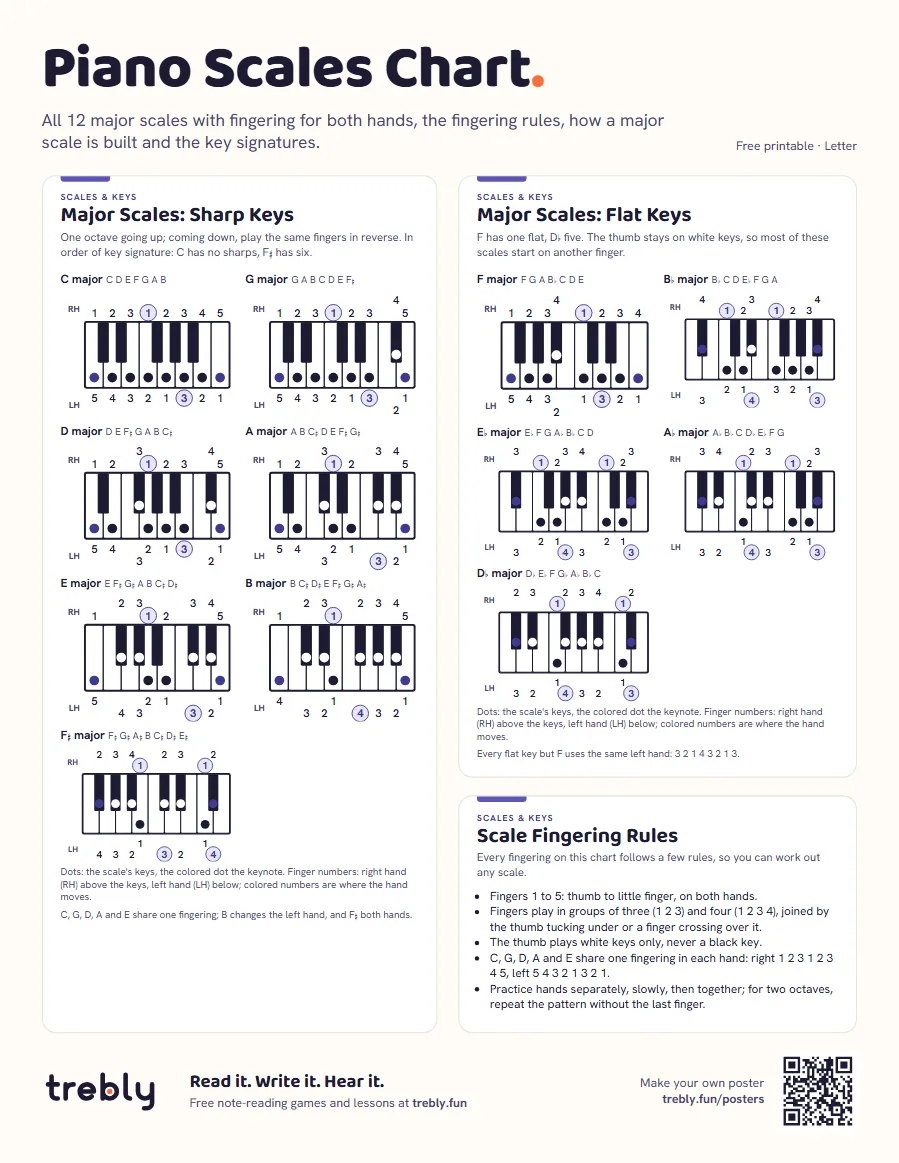
All 12 major scales on the piano, each on its own keyboard, with the right-hand fingering above the keys and the left-hand fingering below, and every thumb tuck and cross-over marked. With a matching minor scales chart, so you have all the major and minor scales. Free in eight sizes, in US or UK music terms.
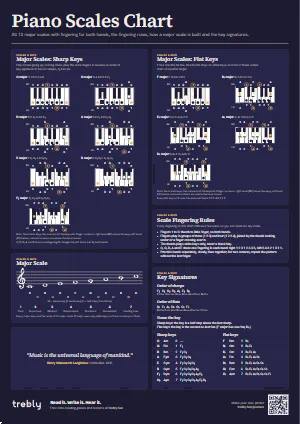
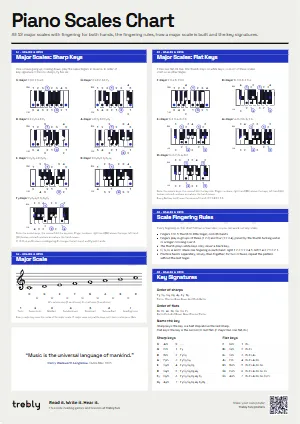
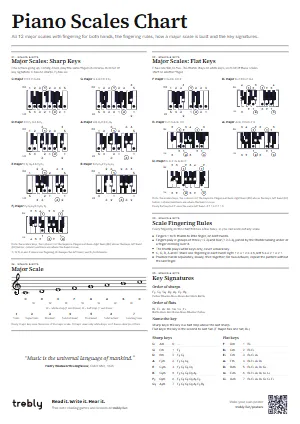
Make it yours: see it in another style
Any US home printer (8.5 × 11 in). A binder, desk or music stand.
Download the PDFLetter, US · 134 KB
Customize this posterChange the sections, style and colors, and add your own title, in the Music Theory Poster Maker. $9 PDF.
✓ Your PDF is downloading
Make this poster yours
- Your own title, like “Mrs. Green’s Music Room”
- Only the sections you teach, or add more
- A different style: Dark, Modern or Minimal
Customize this poster →$9 PDF · try it free first
On the Letter poster (3 sections)
- Major Scales: Sharp Keys
- Major Scales: Flat Keys
- Scale Fingering Rules
Plus a practice tip in the space left over.
The bigger the poster, the more fits: A2 and larger have all 5 sections.
All sizes and files
| Size | Dimensions | Sections | US terms | UK terms |
|---|---|---|---|---|
| Letter | 216 × 279 mm · 8.5 × 11 in | 3 | PDF, 134 KB | PDF, 134 KB |
| A4 | 210 × 297 mm · 8.3 × 11.7 in | 3 | PDF, 134 KB | PDF, 134 KB |
| 11 × 17 in | 279 × 432 mm · 11 × 17 in | 5 | PDF, 164 KB | PDF, 164 KB |
| A3 | 297 × 420 mm · 11.7 × 16.5 in | 5 | PDF, 163 KB | PDF, 163 KB |
| A2 | 420 × 594 mm · 16.5 × 23.4 in | 5 | PDF, 195 KB | PDF, 195 KB |
| 18 × 24 in | 18 × 24 in · 457 × 610 mm | 5 | PDF, 198 KB | PDF, 197 KB |
| A1 | 594 × 841 mm · 23.4 × 33.1 in | 5 | PDF, 202 KB | PDF, 202 KB |
| 24 × 36 in | 24 × 36 in · 610 × 914 mm | 5 | PDF, 205 KB | PDF, 205 KB |
What’s on the piano scales chart
- Major scales, sharp keys: C, G, D, A, E, B and F♯, in order of key signature, each on a keyboard from its keynote up an octave.
- Major scales, flat keys: F, B♭, E♭, A♭ and D♭, the same way.
- Fingering for both hands: right-hand finger numbers above the keys, left-hand below. A circled number marks where the hand moves: the thumb tucks under, or a finger crosses over the thumb.
- Scale fingering rules: groups of three and four fingers, the thumb only on white keys, and the one fingering that C, G, D, A and E share.
- How a major scale is built and key signatures (11 × 17 in and larger): the whole and half steps, and every key’s sharps or flats.
Every scale is spelled from music theory and every fingering is checked: eight fingers per hand, the thumb never on a black key, and only moves a hand can make going up.
How to use it
- Start with C, G, D, A and E. They share one fingering in each hand: right 1 2 3 1 2 3 4 5, left 5 4 3 2 1 3 2 1. Learn it once and five scales follow.
- Hands separately first. Play each hand slowly, saying the finger numbers, and watch for the circled ones: that’s where the thumb goes under or a finger goes over.
- Then the flat keys. B♭, E♭, A♭ and D♭ share one left hand (3 2 1 4 3 2 1 3); only the right hand changes.
- Coming down, play the same fingers in reverse. For two octaves, repeat the pattern without the last finger.
Learn it step by step
The poster is a reminder; these free lessons and guides teach each part, with notes you can play and hear.
- Major Scales: Sharp Keys
- Lesson 28: Build a Major Scale · Major and Minor Scales · Lesson 29: Key Signatures: G and F
- Major Scales: Flat Keys
- Lesson 28: Build a Major Scale · Major and Minor Scales · Lesson 29: Key Signatures: G and F
Questions
Is it really free? Yes. Download it, print as many copies as you like, and share the link. No email or account.
Are these the standard fingerings? Yes: the one-octave fingerings most teachers and graded scale books use. Some teachers prefer a different fingering for a scale or two, so follow your teacher where they differ.
Why is F♯ major shown and not G♭? They’re the same keys on the piano. F♯ (six sharps) completes the sharp keys and D♭ (five flats) the flat keys; G♭ major uses exactly the same fingering as F♯.
What about minor scales? They have a chart of their own, in the same layout: the free piano minor scales chart has all 12 minor scales with fingering, their natural, harmonic and melodic forms, and each one’s relative major. Print the two together for all the major and minor scales.
Which size should I print? Letter or A4 has all 12 scales and the fingering rules: enough for a music stand. 11 × 17 in and larger add how a scale is built and the key signatures.
Can I make my own version? Yes. In the Music Theory Poster Maker you can put your name or your studio’s on it, choose the sections and pick a style. Personalized posters are $9 as a PDF.